

Alaska The Card Game
A slow-paced, salmon-fishing table card game of the Cambio Unlimited Deck

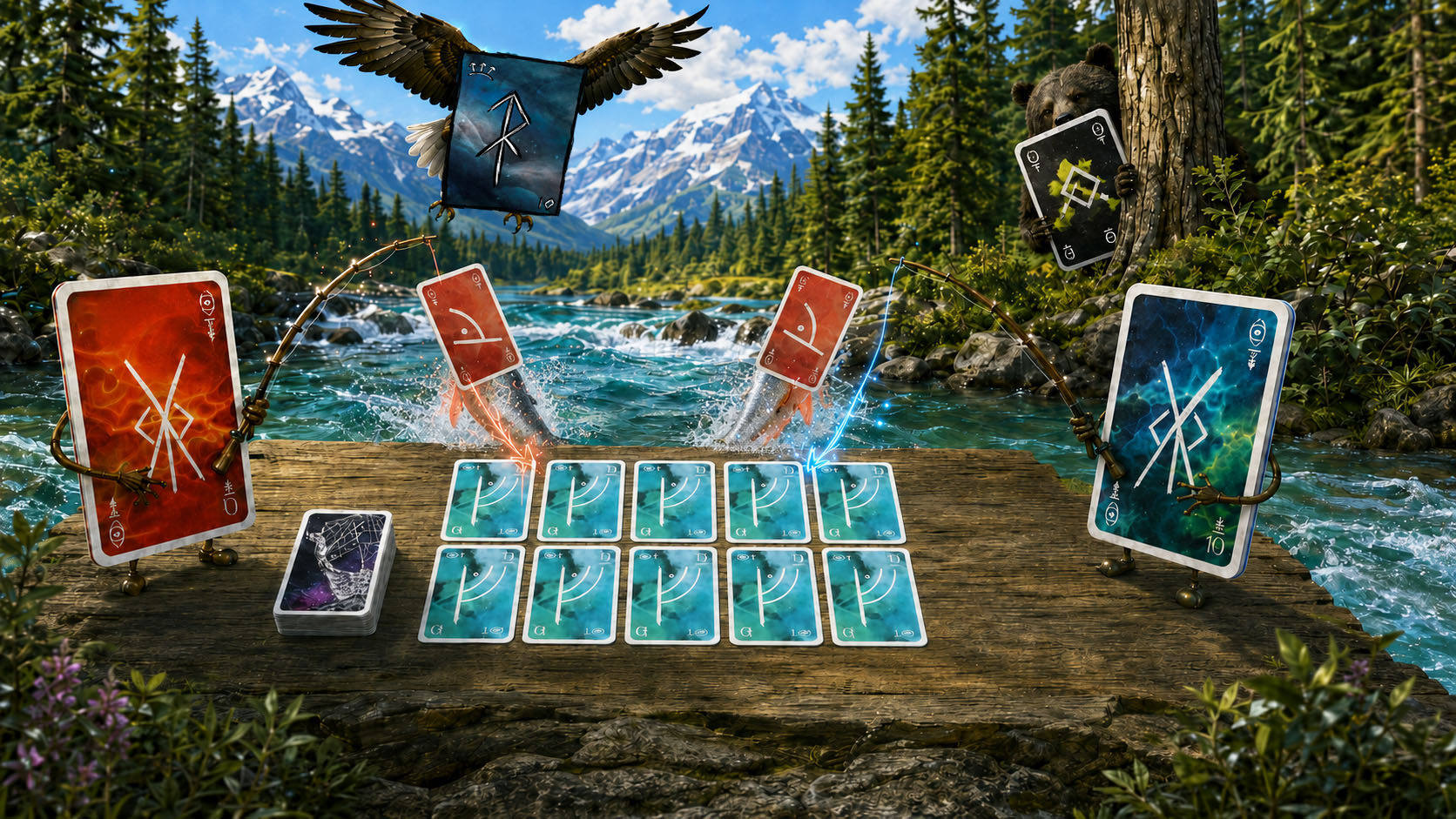

Alaska The Card Game is played with a single Cambio Unlimited deck.
2–6 players
Games take around 10–25 minutes.
Catch the most Salmon.
There are no tiebreakers, you catch what you catch.

Take the 10 River Cards (Blue Runes) from the deck and lay them on a tabletop surface in 2 rows of 5 cards.
River Card 1 is placed in the bottom-left corner of the River.
Continue placing River Cards 2, 3, 4, and 5 from left to right across the bottom row.
Place River Card 6 directly above River Card 5 in the top-right corner.
Continue placing River Cards 7, 8, 9, and 10 from right to left across the top row.
The completed River should look like this:
Top row, from left to right:
10, 9, 8, 7, 6
Bottom row, from left to right:
1, 2, 3, 4, 5
The River Cards remain in these fixed positions for the entire game.
Shuffle the remaining cards to create the draw pile.
Leave space beside the draw pile for a discard pile.
Deal each player 4 hand cards.
Each player may look at their own hand cards at any time.
The person who won the last game goes first.
If it is the first game, the oldest player goes first.
Play moves clockwise to the player on the left.
4. Card Types + Actions

The cards are divided into 4 categories:
Nature Cards
Cast Cards
Angler Cards
Wild Cards
Nature Cards represent the parts of the game that are outside your control.
If you have any Nature Cards in your hand at the beginning of your turn, you must play all of them before playing any other cards.
You do not choose whether to play them—they always happen first.
Nature Cards include:
Salmon Cards
Flow Cards

Salmon Cards (Red Rune)
At the beginning of your turn, if you have any Salmon Cards in your hand, they must be played first before any other card.
Take all Salmon Cards out of your hand and give them to the player on your left.
The player on your left must then place the Salmon Cards across the spaces between adjacent River Cards, following the shape of the River.
Most Salmon Cards are placed horizontally.
Salmon placed between River Cards 5–6 or 10–1 are placed vertically.
The River sections are:
1–2
2–3
3–4
4–5
5–6
6–7
7–8
8–9
9–10
10–1
If you have multiple Salmon Cards, the player to your left chooses a River section for each one.
Two Salmon may not occupy the exact same River section.
Salmon may occupy neighboring sections and overlap across the River Card shared by those sections.
For example:
One Salmon may be between River Cards 2 and 3.
Another Salmon may be between River Cards 3 and 4.
These Salmon overlap River Card 3, but they are in different River sections.
Caught Salmon
Whenever you catch a Salmon, place it face up beside you so everyone can see how many Salmon you have at any moment.

Flow Cards (Swap Rune)
After all Salmon Cards from your hand have been placed into the River, all Flow Cards in your hand must be played.
Discard each Flow Card into the discard pile.
For each Flow Card discarded:
Move every Salmon in the River counterclockwise by 1 River section.

Cast Cards are used to catch Salmon from the River.
To catch a Salmon, discard:
1 Cast Card matching either River Card beside that Salmon
OR
2 Cast Cards whose values add together to match either River Card beside that Salmon
You may not combine more than 2 Cast Cards for a single cast.
For example:
A Salmon between River Cards 4 and 5 may be caught using:
A 4
A 5
2 Cast Cards totaling 4
2 Cast Cards totaling 5
Each cast catches only 1 Salmon.
If the same Cast value could catch more than 1 Salmon, choose which Salmon you are catching.
Remove the caught Salmon from the River and place it face up beside you.

Angler Cards are placed on top of individual River Cards, temporarily covering them.
Only 1 Angler Card may occupy a River Card at a time.
Catching Salmon
As Salmon move through the River with Flow Cards, they may pass Anglers.
When a Salmon passes an Angler, that Angler catches the Salmon.
Salmon caught by Anglers are placed into the discard pile.
For example:
An Angler is covering River Card 4.
A Salmon is between River Cards 3 and 4.
When a Flow Card moves that Salmon to the space between River Cards 4 and 5, it passes the Angler.
The Angler catches the Salmon, and the Salmon is placed into the discard pile.
Hooking an Angler
Sometimes, a Cast you play will match the River Card currently occupied by an Angler.
When this happens, you've hooked the Angler with your lure.
There are different penalties depending on whether you hook a Tourist or a Local.
If a Salmon and an Angler can both be reached by the same Cast, you do not catch the Salmon—you hook the Angler.
The Cast Cards used are discarded normally.


Catching Salmon
A Tourist catches only 1 Salmon.
After catching that Salmon, the Tourist is satisfied with their experience and leaves the River.
Discard the Salmon.
Discard the Tourist.
If multiple Salmon pass the Tourist during the same movement, the Tourist catches only 1 Salmon before being discarded.
Hooking a Tourist
If you hook a Tourist, immediately discard every remaining card in your hand.
Getting the Tourist unhooked takes time, so the rest of your current turn is lost.
Discard the Tourist and do not draw back to 4.
On your next turn, you will not have any cards. End your turn and draw back to 4.
Scaring Away a Local
When you play a Tourist onto a River Card occupied by a Local, the Tourist scares the Local away.
Discard the Local.
Leave the Tourist on that River Card.
Ways to Remove a Tourist
A Tourist may be removed from the River by:
Being hooked.
An Eagle.
A Bear.

Catching Salmon
A Local catches every Salmon that passes it.
The caught Salmon are discarded.
The Local remains in the River catching Salmon until they are removed.
Playing a Local
You may not play a Local onto a River Card occupied by a Tourist.
Hooking a Local
If you hook a Local:
Discard 1 of your previously caught Salmon as an apology offering.
Discard the Local.
If you have not yet caught any Salmon, the Local shakes their head at you in disappointment and disbelief, but takes pity on you and decides to ignore you.
The Local unhooks themself and remains in the River.
There is no other penalty.
The Cast Cards used to hook the Local are discarded normally.
Ways to Remove a Local
A Local may be removed from the River by:
A Salmon offering after hooking the Local.
Playing a Tourist onto the Local's River Card.
An Eagle.
A Bear.

Wild Cards are only played to the discard pile.
They are not placed into the River.
Wild Cards include:
Eagle
Bear
Eagle (Energy Rune)
When you discard an Eagle during your turn, it acts as a wild-card Cast.
Choose any 1 Salmon or Angler in the River.
If you choose a Salmon:
Catch the Salmon.
Place it face up beside you.
If you choose an Angler:
Discard the Angler.
There is no penalty.
Bear (Chaos Rune)
A Bear may be used in 2 different ways.
During Your Turn
Discard a Bear to remove every Angler from the River.
Place all removed Anglers into the discard pile.
Outside Your Turn
Immediately after another player catches a Salmon, you may discard a Bear from your hand.
The Bear will then eat their Salmon.
Discard the Bear and the Salmon the player just caught.
The Bear may be used in this way regardless of how the Salmon was caught.
When used outside your turn, the Bear does not remove Anglers from the River.

Each turn has 4 stages and must be played in this order.
1. Play Salmon Cards
Play every Salmon Card in your hand.
The player to your left chooses the River section where each Salmon is placed.
Salmon Cards must be played before Flow Cards.
2. Play Flow Cards
After all Salmon Cards have entered the River, discard every Flow Card in your hand.
Each Flow Card moves all Salmon counterclockwise by 1 River section.
Resolve each Flow Card and any Angler catches before playing the next Flow Card.
3. Play Cast, Angler, and Wild Cards
You may now play your remaining Cast Cards, Angler Cards, and Wild Cards in any order.
By the end of this stage, you must either:
Play every card in your hand
OR
Keep only 1 card for a future turn.
You may make multiple casts during the same turn.
4. Draw Back to 4
At the end of your turn, draw cards until you have 4 hand cards.
Play then passes to the player on your left.
